



Building large creations for the Carnival Parade
Carnival float with CNC machined heads wins first prize!

The float in the streets of Krabbegat during the carnival parade.
KE Bouwclub Wij in Bergen op Zoom (NL) is a construction club that builds creations for the yearly local carnival parade. The "KE"in their name stands for Royally Recognized, in Dutch "Koninklijk Erkend".
The photo above shows the float that they have built for the 2026 carnival parade (on February 17): it has won the first prize in category 'Large floats'. During Carnival (in Dutch "Vastenavend") the city of Bergen op Zoom is named 'Krabbegat'.

Sculpting polystyrene is a great way to create large lightweight sculptures for a carnival float.
Since the seventies most very large sculptures on a carnival float are made by applying polyester and fiberglass over sculpted clay figures. Bouwclub Wij almost 15 years ago switched to using polystyrene foam (EPS = Expanded PolyStyrene): lightweight, lowcost, better for the environment and for the health of the builders, ánd allowing more detail. The builders manually sculpted large blocks of foam, coated the resulting sculptures with a thin layer of plaster, and then painted them as desired.
in 2026 Bouwclub Wij added an innovation to this method: they now use 3D digital models and CNC machining, achieving results of a very high quality.

The construction of the machine can be light: no large cutting forces.
They built a very large CNC machine: in fact this is a separate room in the large workshop. It is a light machine, perfectly suited for milling polystyrene. The cutter is horizontally oriented: you can imagine this machine as a traditional machine laid on its side. Advantage is that all chips simply can fall down. As you can see they use a very long cutter: a special EPS cutter: D 10 mm, L 150 mm). For this cutter and this light machine stepover and feedrate need to be low: for instance 2 mm stepover, feedrate between 4000 and 8000 mm/min. As the total machining time is not critical this is not a problem.
The design of this machine is open source, you can find it on Piepomaat | 3D CAD Model Library | GrabCAD. Thanks for sharing this design!
Working area of the machine is 1000 x 1000 x 2000 mm. This size was chosen as EPS is sold in standard blocks of 1000 x 2000 mm. The machine uses a MESA 7I96S motion control card, with the LinuxCNC open source control software.
The special EPS cutter has been ordered in China: CNC Foam Mill Cutters.
The spindle motor comes from Germany: AMB-06082806, selected because it can handle cutters up to D=10 mm and is well balanced, which makes the very long cutters run without a problem.
Rotary machining a complete head.
The rotation axis (fourth axis) rotates the material round a vertical axis. Note that the block of foam has been carefully prepared: it is not larger than needed for this geometry, to minimize the number of roughing layers are needed (despite the very long cutter).
Total machining time for this head has been about 12 hours, including indexed machining of undercut areas behind the ears and the nostrils. For this appplication such high machining time is not a problem: building a float takes a lot of time anyway.
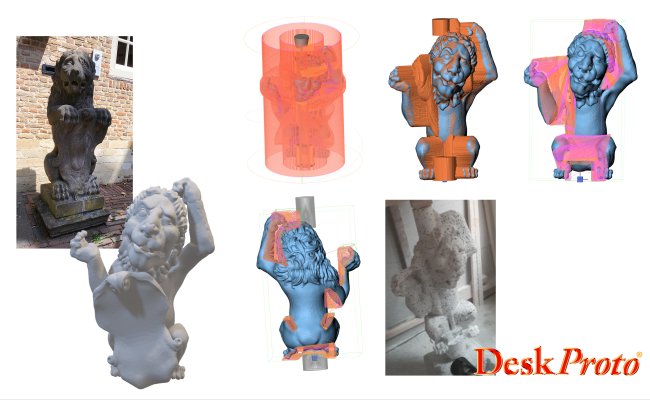
For this complex geometry rotary machining is not enough.
This project has been done by advanced DeskProto users, as you can see in the screenshots above. Using only rotary toolpaths (continuous rotation) not all details of this statue could be machined. So in addition indexed machining has been used: three-axis toolpaths from several sides, only applied where needed.
The image on the top left shows a stone sculpture in this city, that has been used as inspiration for this foam model. The red lines in a cylinder-shape are the rotary toolpaths, the other images show toolpaths for indexed machining.

When the model is too large for this machine partitioning is needed.
Even more advanced is the partitioning that was needed for the largest head (the King). This part was way too large to fit in the machine (even for this large machine), so it needed to be divided into smaller parts that could be machined and then later assembled. The orange lines in the Blender screenshot show the partitioning boundaries.On the right you see one of these parts in DeskProto, with CNC toolpaths.
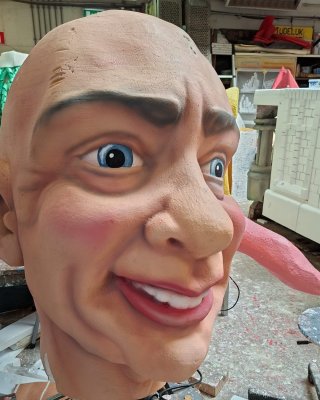

Two of the heads, after coating with plaster and painting in color.
The coating is not only a base for the paint, it also makes the resulting sculpture stronger: a stiff skin round a foam core is a sandwich construction. Adding the color then makes an enormous difference: the sculptures now come to life!
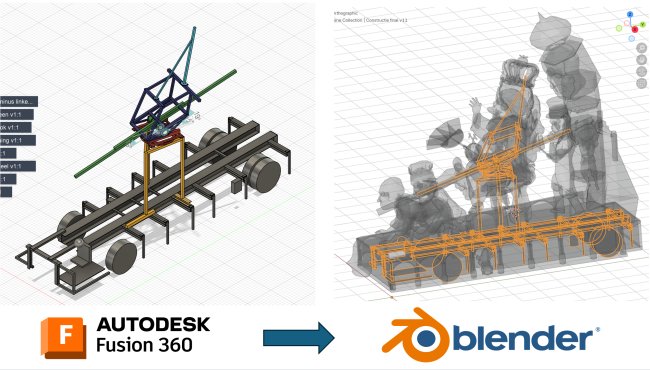
Design models for the mechanical parts of the float..
Creating a carnival float involves much more work than creating and painting these sculptures. The float needed to be constructed and all moving parts needed to be manufactured. As you can see above this as well was a complicated design task, as some of the figures on the float are in fact moving parts. Several models have been used: mechanical CAD models as shown above, artistic CAD models, and also physical scale models of the float.
Video clip of the parade, made by local TV station ZuidWest TV (1 min 49 sec)
The result of this project was a great carnival float. No problems during the parade: all figures stayed alive and all moving parts kept moving. Only the weather was not perfect: some rain during the first half of the total parade. Finally winning a first prize was of course a perfect end of the day.
The video is a clip from a TV report made by ZuidWest TV. You can find the complete report (1 h 52 min) here: Optocht Krabbegat 2026 - Bergen op Zoom. ZuidWest TV kindly permitted us to use the clip: thanks ! The video is HD quality (1920x1080 pixels), the audio comment is in Dutch.
When you are interested to start a similar project: Bouwclub Wij is willing to share their know-how on this application.